We thought we would show you the current rig which we are operating with.
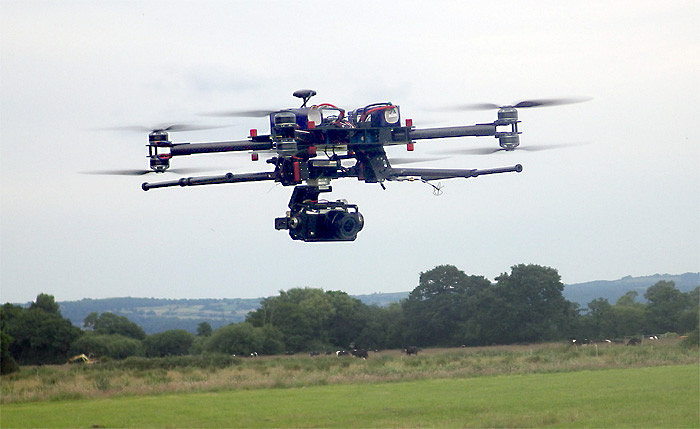 Cortex Octocopter
It's based on a carbon fibre frame made by Cortex and is configured as an Octocopter; that is, with four arms and two independent motors mounted on each arm. The benefit of a configuration of this type is that it gives optimum control in the event of a component failure; the craft will remain airborne and under full control even if a motor fails completely. Further redundancy is provided by the use of two batteries in parallel, which in normal conditions gives us about 20 minutes flight time.
We use the Pixhawk flight control system for this rig, and as is pretty standard for such UAV systems this integrates GPS positioning to ensure both that the craft can hold its position accurately if required without intervention and also that it will return to its take-off position automatically in the unlikely event that communication with the pilot is lost.
The craft is fitted with a gimbal system to support the camera. After much trial and error we adopted a design from Arris Zhaoyun which provides exceptional stability and levelling in all three axes; this camera platform can be controlled from the ground to give smooth and fluid control of the camera angle over 360 degrees.
The camera normally used is a Samsung NX500 which we find gives outstanding quality for its size. It records FHD video [1920x1080] at up to 50/60 fps - even faster for slow-motion at standard HD; it offers UHD [3840x2160] at 25/30 fps and 4K [4096x2160] at 24 fps. Its highest quality capture is around 70Mb/sec. The camera saves using the H.265/HEVC codec; this gives far better compression ratios than H.264 for equivalent quality; recent versions of professional editing systems will read this format directly but for other cases the file can be transcoded to H.264/AVC (or other formats) with a number of applications.
The camera has a 4:1 optical zoom capability which can be controlled from the ground and takes outstanding 28 Megapixel RAW stills.
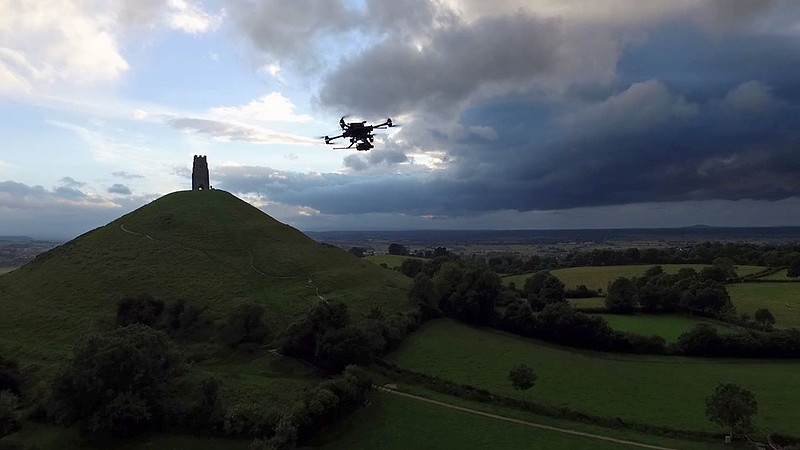 Cortex over Glastonbury Tor
We also have available the small, lightweight DJI Phantom 3 which offers less flexibility on the photographic front but also has 4K video and it can sometimes go where the Cortex can't! The photo above is a screen-grab from 4K video taken from the Phantom while both craft were flying near Glastonbury Tor recently.
And we're working on getting a Blackmagic Micro Cinema camera aloft when we've identified a suitable gimbal; more to come on this blog shortly..

